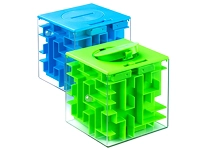
Explore Types of Brain Teaser Puzzles
Brain teaser puzzles invite you to solve a problem through observation, logic, spatial reasoning, or experimentation. Popular types include interlocking puzzles, where pieces must be separated or assembled; disentanglement puzzles, which challenge you to free a loop or ring; and sequential puzzles that require moves in a particular order. Logic and deduction games use clues, while packing puzzles ask you to fit shapes into a defined space. Three-dimensional brain teasers may involve rotating, stacking, or reconfiguring components, and classic twisty puzzles test pattern recognition and planning. Each format offers a different kind of challenge, from a quick tabletop diversion to a longer solo activity. Understanding these puzzle types helps you narrow your search by the experience you want, whether that is solving a compact mechanical challenge or working through a multi-step logic problem.
- Choose from logic, mechanical, spatial, and sequential challenges
- Explore solo puzzles and group-friendly brain games
- Compare compact handheld designs with larger tabletop formats
Understand Puzzle Mechanics and Formats
The mechanism determines how a brain teaser works and what kind of reasoning it rewards. Sliding-tile puzzles require you to plan moves around an empty space; maze puzzles rely on route finding; and combination puzzles may require specific rotations, alignments, or sequences. Wooden assembly puzzles focus on how pieces connect, while metal disentanglement designs often depend on noticing a hidden path rather than applying force. Some puzzles provide a goal or clues, whereas open-ended designs encourage repeated experimentation. Check whether a product is intended for one solver, a pair, or a group, and whether its instructions include hints for getting unstuck. If you are browsing unfamiliar formats, Ubuy can help you discover international brain teaser puzzles and compare different styles. Product descriptions and images can help you understand the mechanism before choosing.
- Look for move-based, mechanical, maze, and assembly formats
- Check whether clues or solution guidance are included
- Match the puzzle format to solo or shared play
Compare Materials, Build, and Design
Materials influence a puzzle's feel, durability, weight, and visual appeal. Wood offers a warm tactile experience and is common in interlocking and packing puzzles; metal is often used for compact disentanglement challenges; and plastic can support lightweight, colorful twist or sliding designs. Some puzzles combine materials, such as a wooden board with molded pieces or a metal mechanism housed in a case. Look for smooth edges, well-fitted components, clearly visible markings, and pieces that move as intended without excessive force. Recognized puzzle names and makers such as Rubik's, Hanayama, and Ravensburger are useful search terms when comparing familiar formats, though designs vary by product. Consider whether the puzzle will be handled frequently, displayed between sessions, or packed for travel, and select a construction that suits its intended use.
- Compare wood, metal, plastic, and mixed-material designs
- Check fit, finish, markings, and ease of handling
- Consider whether the puzzle is for play, display, or travel
Choose a Challenge Level That Fits
Difficulty can depend on more than the number of pieces: a small puzzle may demand precise spatial reasoning, while a larger one may be approachable through trial and error. Consider the solver's familiarity with logic games, patience for repeated attempts, and preference for clues or independent discovery. Beginner-friendly options often have a clear objective and simple rules, while advanced brain teasers may require several linked deductions or careful control of moving parts. For a shared activity, choose a format that lets people discuss possibilities and take turns testing ideas. If purchasing for a collection, a mix of mechanisms and challenge levels can keep sessions varied. Check product details for suggested age guidance and any small components, and use those details to judge suitability for the intended solver rather than relying on appearance alone.
- Assess reasoning demands as well as piece count
- Choose clue-supported or open-ended play to suit preferences
- Review age guidance and small-part details
Use, Store, and Care for Brain Teasers
Brain teaser puzzles work well for quiet breaks, family game sessions, travel, classrooms, and thoughtful gifts, with the best format depending on the setting. Pocket-sized metal or plastic designs are easy to carry, while larger wooden puzzles can make a focused tabletop activity. Some products include a storage pouch, tray, or display stand; others benefit from a small container to keep loose pieces together. Follow the maker's instructions, avoid forcing parts, and return components to their intended position after play when possible. Keep wooden puzzles dry and wipe surfaces gently; clean other materials with a soft cloth unless product guidance specifies otherwise. For puzzles with multiple pieces, take a quick inventory before storing them. A clear solution guide can help when a puzzle is shared, but keeping hints separate can preserve the challenge for future solvers.
- Match size and setup to home, travel, or group play
- Store loose pieces and instructions together
- Follow care guidance and avoid forcing mechanisms
Select the Right brain teaser puzzles
Start by deciding who will solve the puzzle, where it will be used, and what kind of challenge feels enjoyable rather than frustrating. Compare the puzzle type, mechanism, materials, dimensions, and stated difficulty, then check whether instructions, hints, or a storage accessory are included. For gifting, consider the recipient's interests: mechanical designs suit hands-on experimentation, while logic and deduction puzzles appeal to those who enjoy working through clues. If you are building a collection, vary the mechanics instead of choosing several puzzles that test the same skill. Read product specifications carefully, especially when piece count, size, or assembly requirements matter. Ubuy offers a place to discover international puzzle products and compare options across formats. A well-matched brain teaser gives the solver a clear goal, satisfying experimentation, and a reason to return for another attempt.
- Prioritize solver, setting, mechanism, and challenge level
- Compare specifications, instructions, and included accessories
- Choose variety for a more engaging puzzle collection